Technology
INFRARED (IR) MOLECULAR SPECTROSCOPY
Molecules can be in different excited states: they can stretch along their bonds, vibrate around their center of mass, and rotate around one of their axes. Like a stretching spring, these excitations store energy. The energy of many of these excitations corresponds to infrared (IR) wavelengths. These IR wavelengths are characteristic of a specific molecule, so we can use them as "fingerprints" to identify molecules
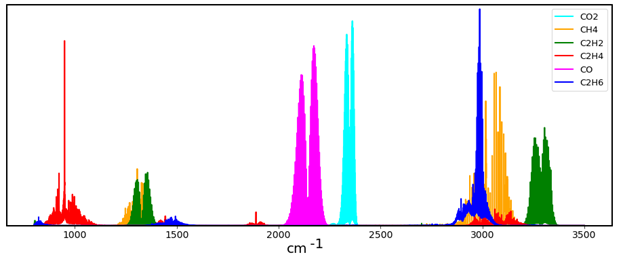
Fig. IR absorption spectra for several types of molecules
TDLAS technology
TDLAS means tunable diode laser absorption technology. TDLAS measures the wavelength-dependent absorption of light through a gas medium composed of various types of molecules.
The emission wavelength of the tunable diode laser is tuned over the characteristic absorption lines of a species in the gas in the path of the laser beam. This causes a reduction in measured signal intensity due to absorption, which can be detected by a photodiode and then used to determine the gas concentration.
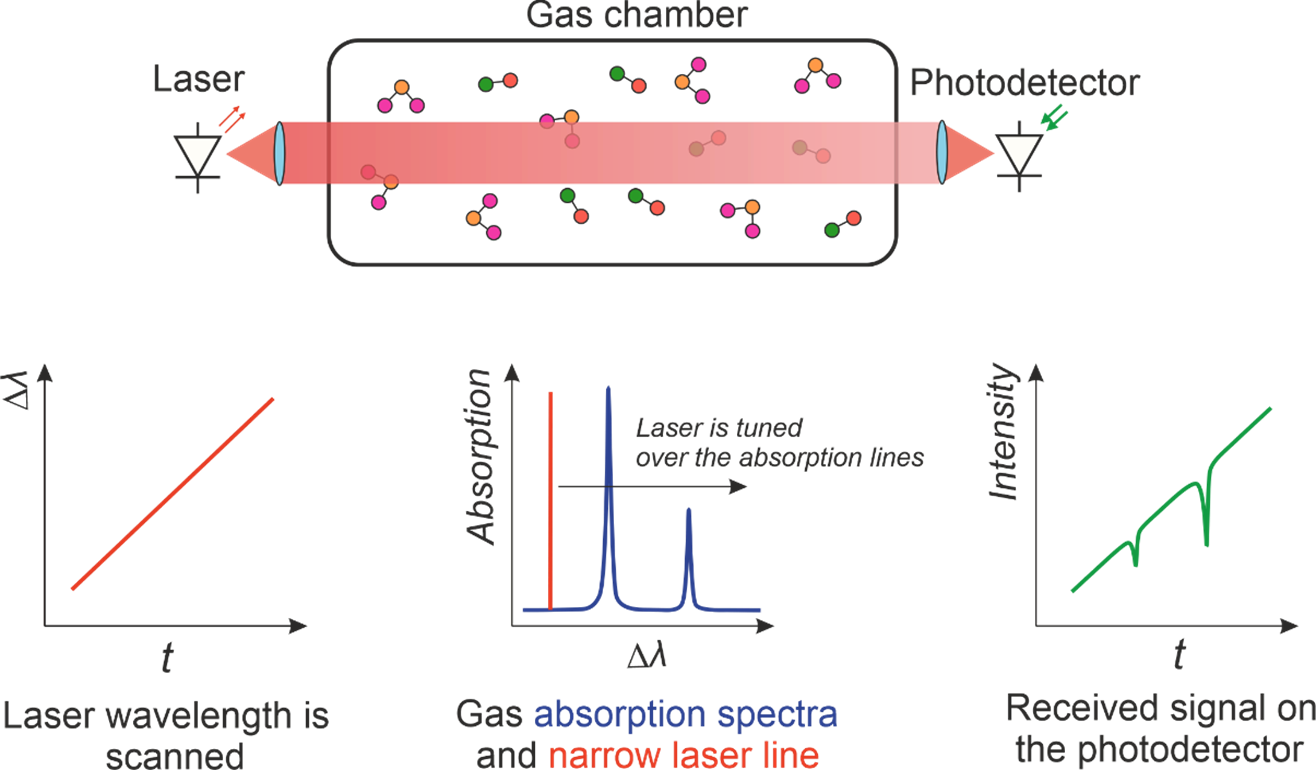
Fig. TDLAS explanation
TDLAS key features
TWhy TDLAS is the best solution for DGA
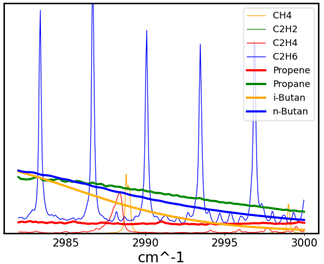
A narrow linewidth laser used in TDLAS performs to measure individual absorption lines because laser linewidth is much lower than absorption linewidth. Common spectroscopy methods for DGA, such as NDIR (non-dispersive infrared) or PAS (photoacoustic spectroscopy), are based on broadband light sources, the which spectra are narrowed by optics filters. Here is an example of how TDLS and NDIR sense the hydrocarbons.
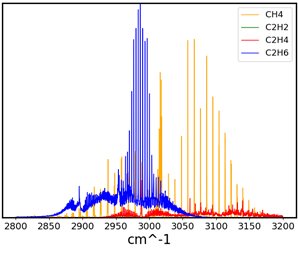
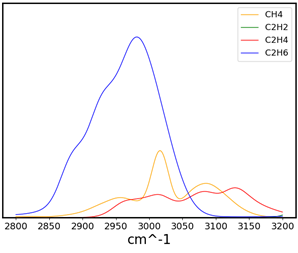
NDIR doesn't resolve the fine structure of absorption spectra. Separating hydrocarbons from each other is a challenge in this case, but it is still possible.
In terms of infrared molecular spectroscopy, DGA is not only about measuring diagnostic gases, but also measuring diagnostic gases in the presence of VOC (volatile organic compounds) dissolved in the oil. Transformer oil dissolves many species such as propene, propane, butane, ethanal, methanol, and many others. Here is an example of how TDLS and NDIR sense the diagnostic hydrocarbons in the presence of some other molecules.
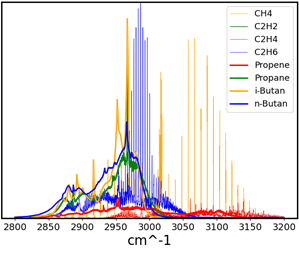
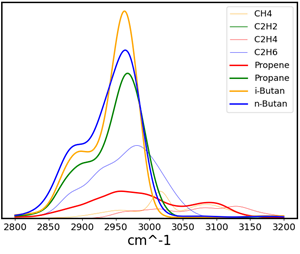
There is no chance to separate hydrocarbons in the presence of VOC in the case of NDIR. This is because NDIR lacks information about the fine structure in absorption spectra. TDLAS can be used to measure individual absorption lines despite very strong interference from VOC (see figure). The optimum spectral range should be chosen carefully. .