TCIM MAYAK
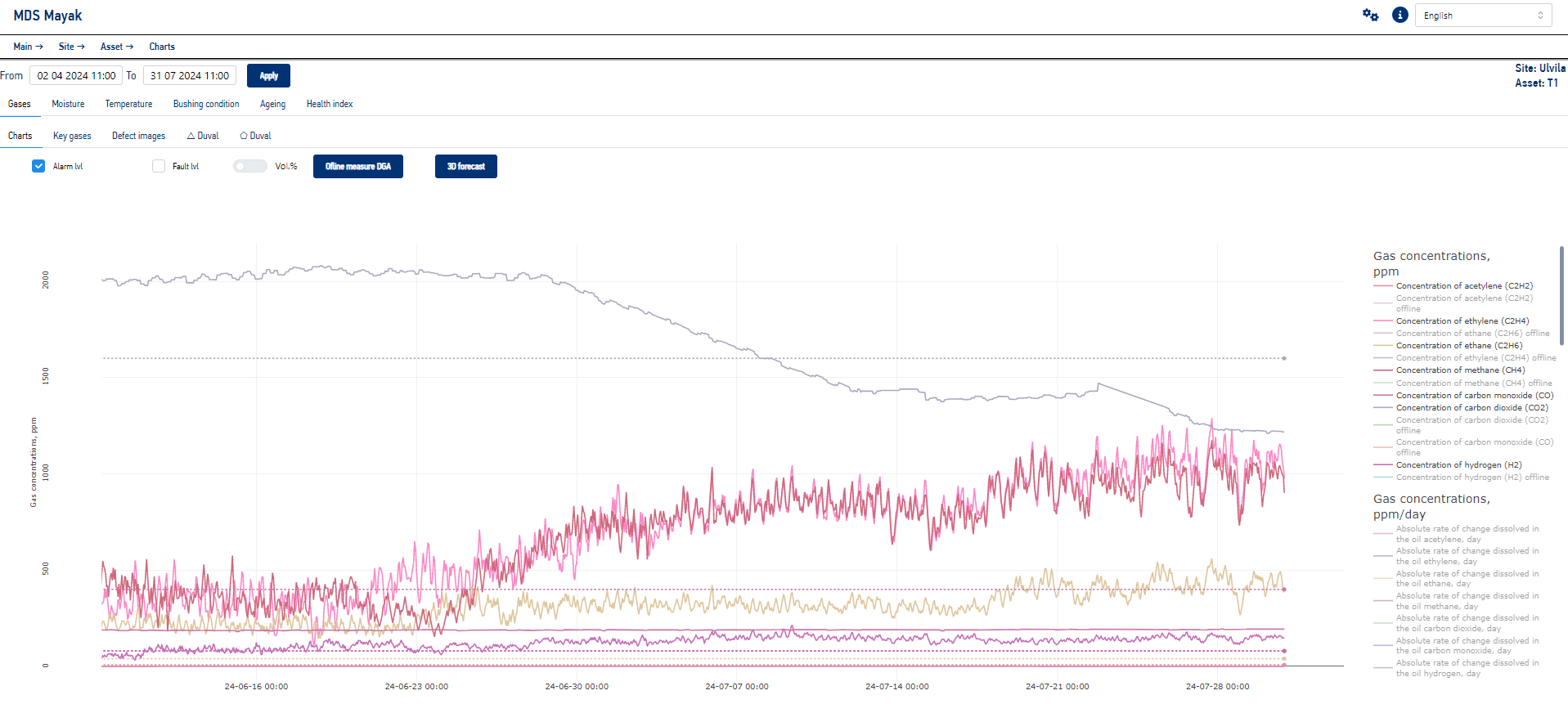
TCIM MAYAK is a software and hardware tool for intelligent online diagnostics. By analyzing the received data, it provides timely and well-balanced recommendations to personnel regarding necessary maintenance and repair operations, supporting the operational dispatch control of a fleet of power transformers.
Unlike classic online monitoring systems that only provide a prompt assessment of the technical condition of equipment, the modern TCIM MAYAK system system has a number of key advantages:

Response to new challenges
The software for MAYAK automated monitoring and diagnostics system allows every user to receive an adequate and personalized scope of required information at the right time, at different levels of the organizational structure of the utility, based on the results of monitoring and diagnostics, including the assessment of the remaining useful life of each transformer.
Specific features of the software of MAYAK automated monitoring and diagnostics system:
- Advanced calculation models take into consideration the mutual influence of various factors, such as: temperature, load, gas concentrations.
- The automated system imports and takes into account data from external information systems;
- Data integration with utility IT systems.
What has happened?
Why has this happened?
What will happen?
What should be done to avoid this?
A state-of-the-art automated monitoring and diagnostics system must
- Identify signs of an incipient defect in between offline measurements;
- Automatically provide maintenance recommendations;
- Deliver maintenance recommendations to intended asset operators
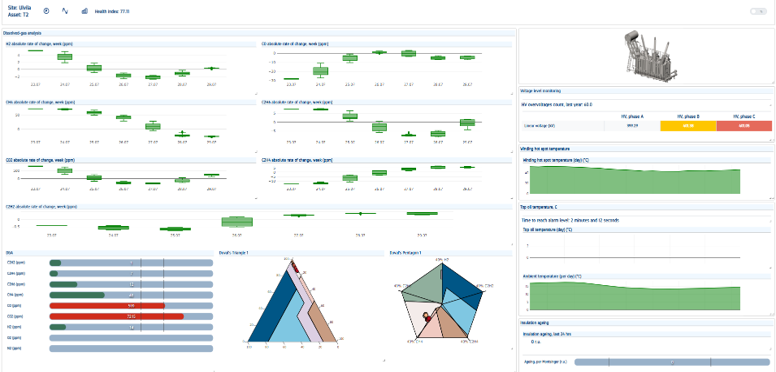
Unlike classical on-line monitoring systems, which provide the assessment of the asset technical state, MAYAK not only assesses the current technical state of power
transformers, but also issues control signals and recommendations for the maintenance personnel on necessary changes in the operating mode and on maintenance and repair operations.

Importance of off-line data
The information about taken repair measures (degassing, oil recovery, oil replacement, drying of solid insulation, etc.), coming from the off-line subsystem, affects:
- adjustment of diagnostic models, such as DGA forecasts and insulation ageing;
- changes in parameter threshold values.
Some of the data from off-line tests and measurements are used to update the results of calculations made using on-line data. For example, water contents of paper can be accounted for when assessing the ageing rate.
The assessment of the health of power transformers, made by the offline data analysis subsystem, in the form of the nature and type of a defect, severity (localization). Operational personnel recommendations are based on the calculated health index that relies on the nature and type of defect and its severity. For example, consideration of influence of the oil oxidation degree when calculating the solid insulation ageing rate.
The assessment of the health of power transformers, made by the off-line data analysis subsystem, in the form of the index of technical state of power transformer winding, is used to predict the load capacity of a particular power transformer. Load capacity bounds are calculated based on the current health index assessment from the offline subsystem.
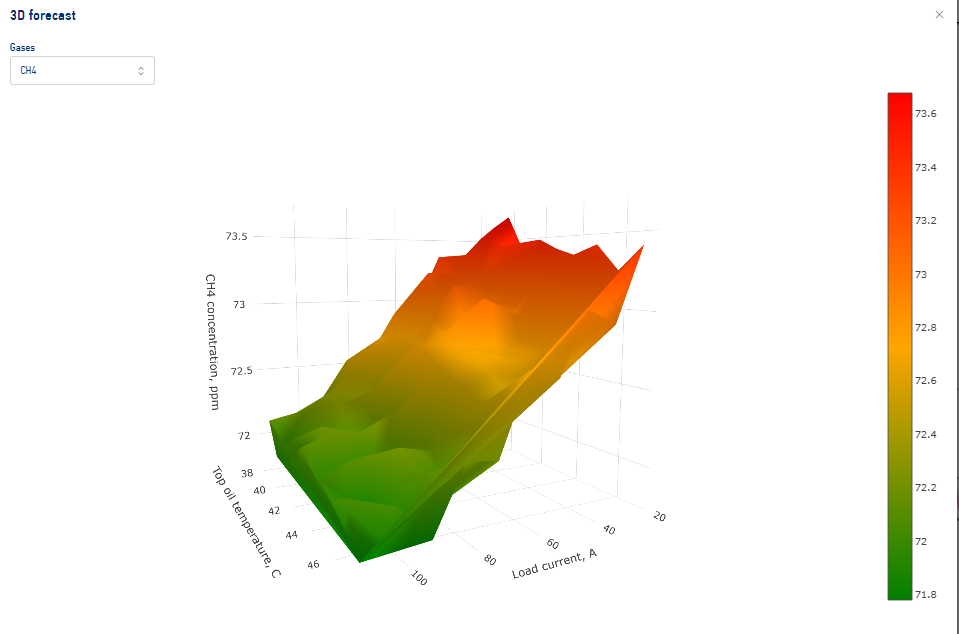
Prediction feature by the software for MAYAK automated monitoring and diagnostics system
The prediction accuracy about 90%
Combination of off-line and on-line data
The integrated approach to monitoring and diagnostics is practically useful to prevent defects at an early stage.
Specific features of off-line monitoring:
- Large standardization base.
- Standardized measurement methods.
- Wider range of measurement oil parameters.
- Good applicability for slowly developing defects.
- Human involvement required
Specific features of on-line monitoring:
- Multiple monitoring technologies.
- Performed frequently and suitable for rapidly developing defects.
- Foundation for condition-based maintenance.
- Automatic.